
$42.00
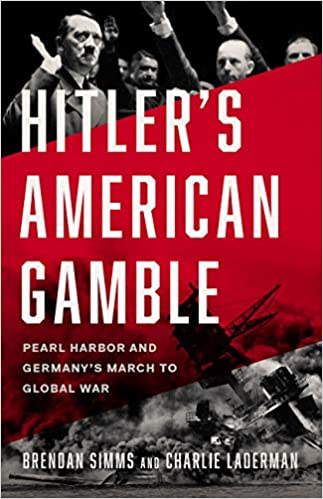
Hitler’s American Gamble explores the five pivotal days between Pearl Harbor and Hitler’s declaration of war on the United States. Drawing on extensive archival research, historians Brendan Simms and Charlie Laderman argue that Hitler’s decision was a calculated gamble, not an irrational impulse—and that December 11, 1941, was the decisive turning point that united separate conflicts into a truly global war.
Description
An “absorbing” and “visceral” (The New York Times) account of five days that transformed the course of the twentieth century—from Japan’s attack on Pearl Harbor to Hitler’s declaration of war on the United States.
By early December 1941, war had reshaped much of the world. Nazi Germany occupied most of continental Europe, while the Second Sino-Japanese War had turned China into a vast battleground. Yet these conflicts had not fully converged into a single global struggle, and the United States remained formally at peace.
Hitler’s American Gamble recounts the pivotal days of December 7–11, tracing the decisions that brought these conflicts together. Drawing on extensive archival research, historians Brendan Simms and Charlie Laderman argue that Hitler’s declaration of war was not an inexplicable act of bloodlust, but a calculated gamble whose logic emerges only when viewed in a global context.
Challenging familiar accounts of America’s entry into the war, the authors make the case that December 11—not Pearl Harbor alone—was the decisive turning point that fused separate conflicts into a world war and transformed international history.
Additional information
| Weight | 2.2 lbs |
|---|---|
| Dimensions | 9.1 × 6.0 × 1.8 in |
Related products
-

Hitler’s Revolution
Price range: $16.00 through $36.00Select options This product has multiple variants. The options may be chosen on the product page -
Who Started World War II
Price range: $20.00 through $43.00Select options This product has multiple variants. The options may be chosen on the product page -
Nuremberg: The Last Battle
$54.89Select options This product has multiple variants. The options may be chosen on the product page -
Stalin’s War of Extermination 1941-1945
Price range: $17.50 through $38.00Select options This product has multiple variants. The options may be chosen on the product page


